Context
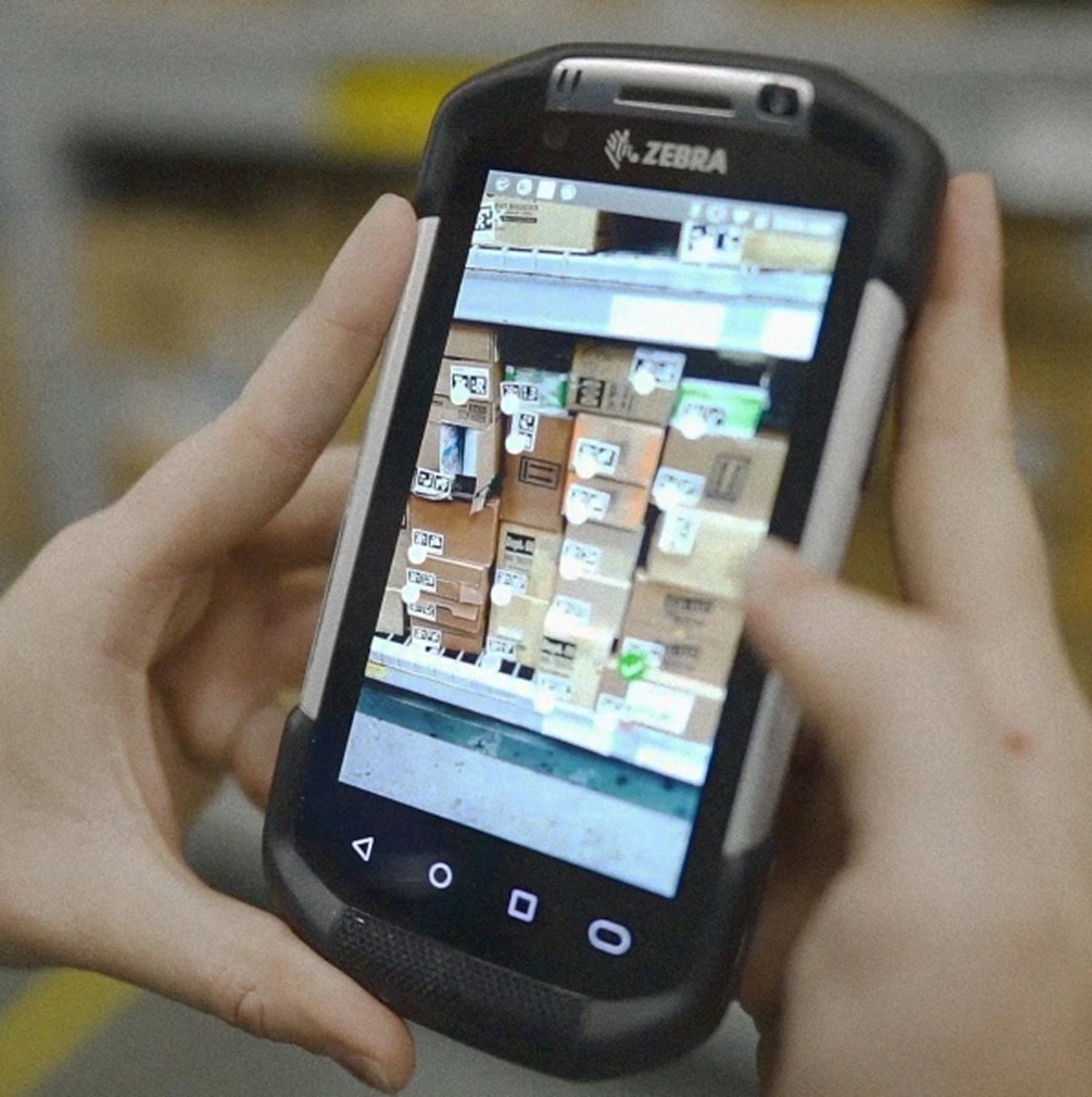
A retail supercenter holds 15,000 backroom boxes. Associates couldn't inventory them fast enough.
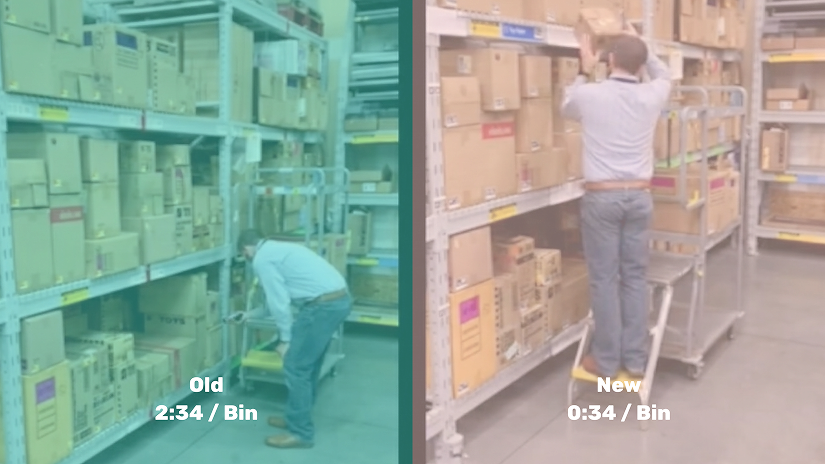
The target was a full scan of every backroom bin once every two weeks. At 2:34 per bin, that required 321 labor hours per week — more than most stores had available for scanning alone, and competing with every other backroom task: unloading trucks, stocking shelves, handling freight. Completion wasn't behind. It was structurally impossible. When associates couldn't move fast enough, shelves emptied. When the system produced results they couldn't rely on, they stopped trying to use it correctly. The tool and the process were failing in tandem.
System Failure
Eight structural problems. Two were doing the real damage: it took too long, and nobody trusted the data.
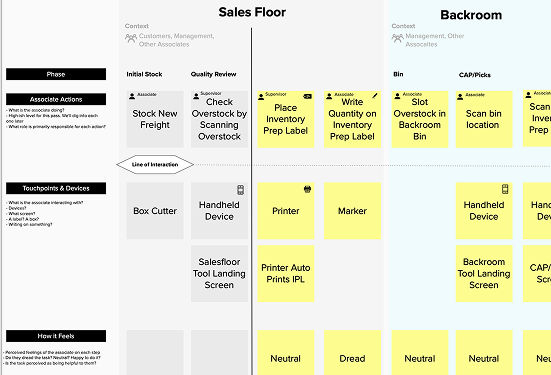
Before drawing anything, I designed the research framework: a service blueprint mapping every action, touchpoint, role, emotional state, and failure point across the process. Eight problems surfaced. Most were contributing factors. Two were load-bearing: the process couldn't be completed in the time available, and associates had systematically disengaged from the data. The existing tool had a SUS score of 48 — well below the acceptable threshold. A UI refresh wasn't going to fix either problem.
The Reframe
Product knew the system was broken. They didn't know how to see it as two separate problems.
Speed and trust look like one problem. They aren't. A faster process doesn't automatically restore confidence in data that's been unreliable for months. And a trust intervention that doesn't address completion time leaves associates exhausted and skeptical. I helped reframe the work as two distinct design challenges: a process associates could actually complete, and a system they could actually believe.
Process & Key Decisions
We evaluated drones, RFID, AR headsets, and physical reconfigurations. The right answer was already in every associate's hand.
I prioritized 15+ pain points by impact and downstream effect, then explored three solution dimensions simultaneously.
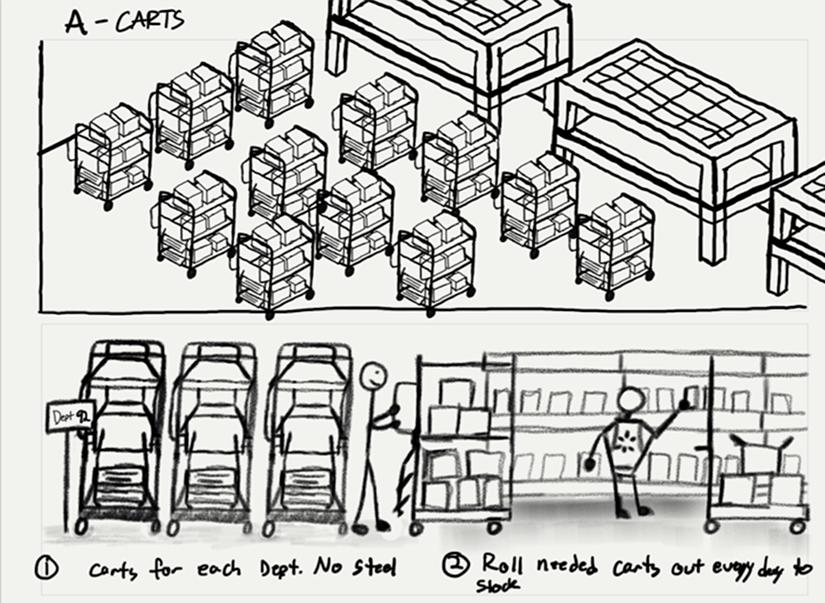
Environment — Prototyped physical backroom reconfigurations across multiple stores. Most experiments failed, but bin renumbering and reconfiguration helped us toward a solution.
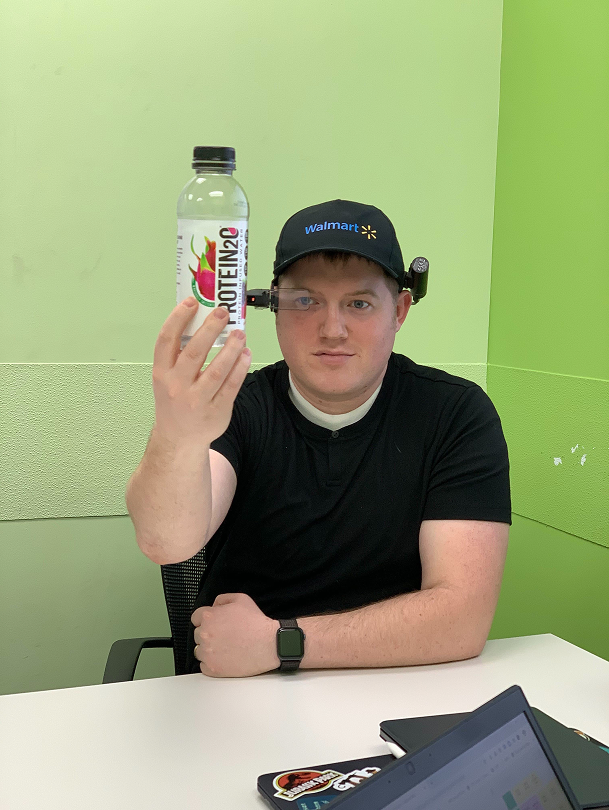
Technology — Evaluated RFID, drones, fixed cameras, AR headsets, and more. Completely removed devices from two departments, causing chaos. Headsets were technically interesting, but operationally impractical at Walmart's scale. The Zebra handheld — already in every associate's hand, already part of the workflow — was the answer.
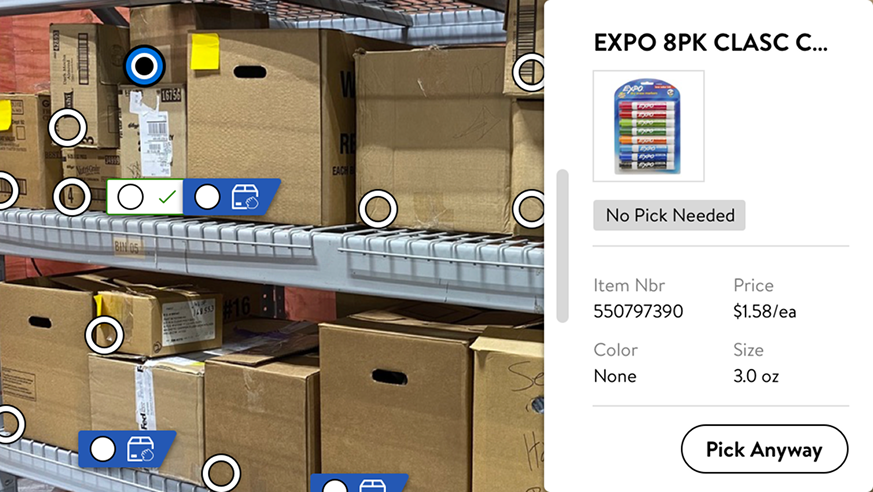
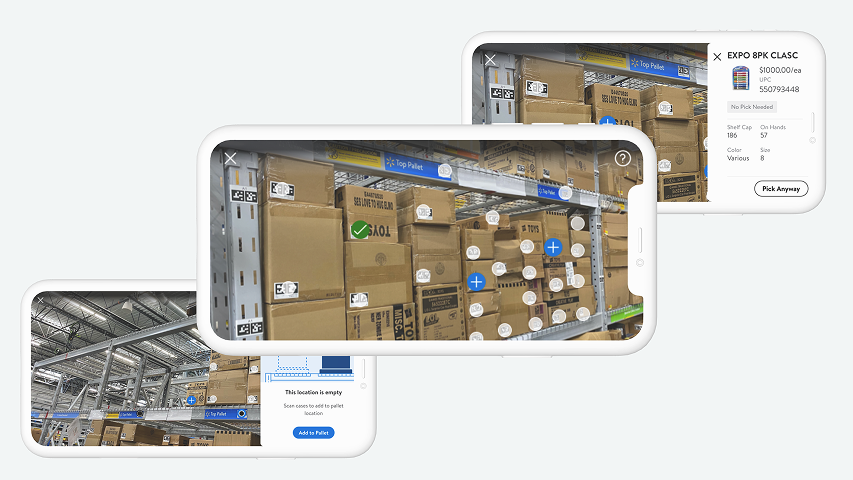
UI — Stripped the AR overlay to what was genuinely actionable. Thumb-sized markers: blue if it needed to go to the sales floor, long-press for detail. Nothing else made the cut. The process collapsed from a multi-branch flow to three steps: point, tap, put.
Outcomes & Impact
2:34 per bin became 0:42. 321 hours of weekly labor became 87. Associates said they trusted the system again.
73% reduction in time per bin, confirmed by timed task comparisons in pilot stores and independently reported by FastCompany. The bi-weekly cycle that once required 321 labor hours per store now requires 87 — recovering 233 hours per week, roughly the equivalent of 6 full-time backroom roles redirected from scanning to higher-value work. Associates reported that counting inventory felt easier and that they believed the data again.
Launched at 3,500 stores. Rolled out chain-wide. Still in production today.
73% reduction in time per bin. 0:42 per bin, down from 2:34. Launched at 3,500 stores and rolled out chain-wide. Associates reported trusting the data again.
Reflection
The most valuable artifact was the service blueprint, not the UI.
The blueprint is where the structural failure became legible — showing us that speed and trust should be separated into two distinct problems that needed two distinct design responses. If I revisited anything: I'd instrument trust recovery as a measurable signal from day one. SUS captures usability. It doesn't capture the moment someone stops working around a system and starts working with it.